


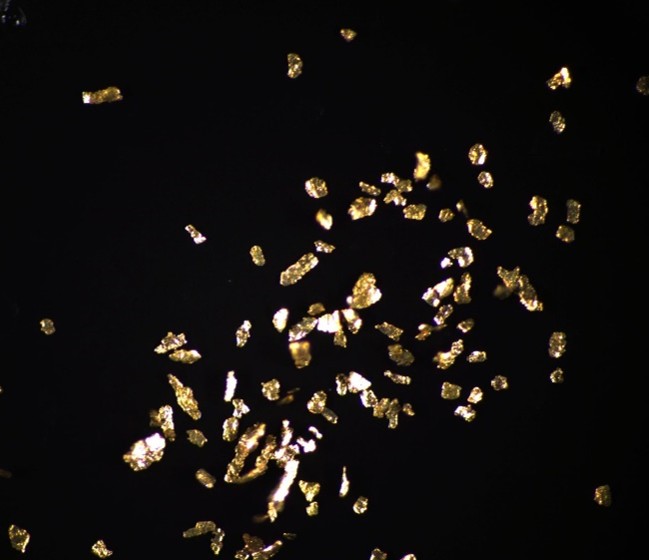
Identification of particles with the Raman-LIBS-System CORALIS
The secure identification of particles is of importance in several fields, e.g., material testing, technical cleanliness and forensics. Especially in the latter two areas, precise knowledge of the material type of a found particle is essential for determining its origin or attribution. Here we want to demonstrate the potential of our combined Raman-LIBS-System (CORALIS) for the analysis of different particles.
Both LIBS and Raman are optical spectroscopy methods. Raman spectroscopy can identify the molecular composition and is therefore suitable for organic and crystalline samples, among other minerals and polymers. LIBS (laser-induced breakdown spectroscopy) identifies the elemental composition of the particles and is therefore very suitable for metal particles as well as for mineralogical samples. The advantage of LIBS for this application is that it can detect nearly all elements, can be performed in air, is fast and requires no sample preparation. With the CORALIS instrument Raman and LIBS measurements can be performed sequentially within one run. With the combination extensive chemical information on the sample can be obtained (Figure 1).
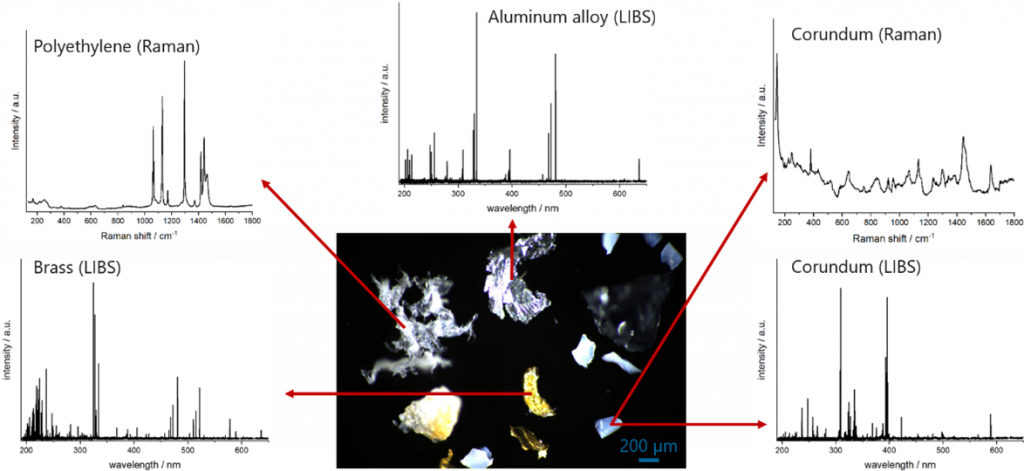
Figure 1: Microscopic image as well as LIBS and Raman spectra of different particles obtained with the CORALIS instrument.
Due to the small laser spot and the high resolution of the imaging optics of the instrument even particles down to a size of 50µm can be analysed (Figure 2).
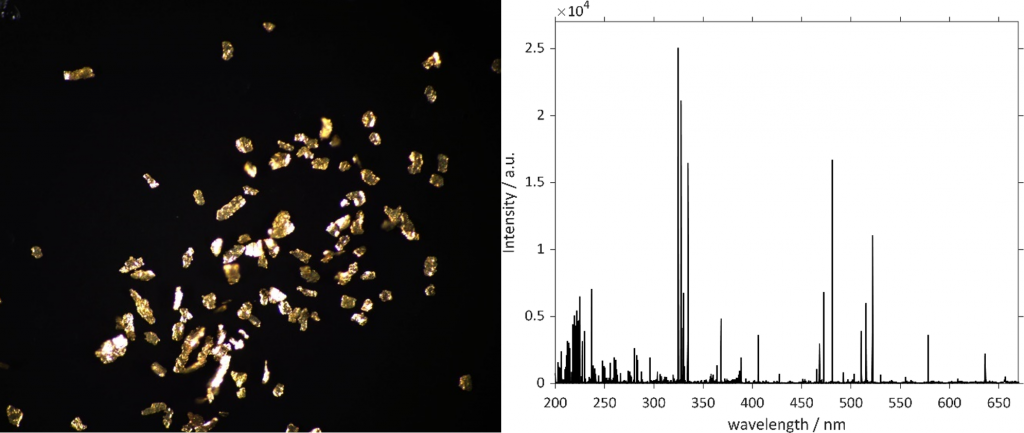
Figure 2: Micrograph (left) and LIBS spectrum (right) of brass particles with a Ferret diameter smaller than 45µm. Both the image and the spectrum were recorded with the CORALIS instrument. The LIBS spectrum was measured with a laser wavelength of 1064 nm and an energy of 5mJ per pulse. Due to the small size of the particles only two pulses were accumulated for the spectrum.
For the analysis several methods are available on the instrument.
For LIBS a classification method is available for three base classes (aluminium, iron, copper) and differing numbers of subclasses (in total 12 classes) which are shown in Figure 3.
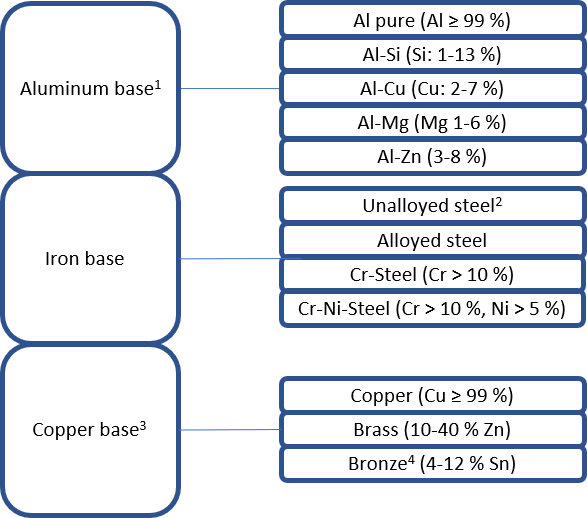
Figure 3: Base and subclasses that could be identified with the material classification. 1Classification and concentration ranges in accordance to DIN EN 573-3:2019, 2classification in accordance with EN 10029_2000, 3classification in accordance with „Deutsches Kupferinstitut“, 4incl. gun metal
If the material doesn’t belong to one of these classes a line identification can be performed on the spectrum to obtain information about the elements present in the sample. When aluminum or alloyed steel is detected additional information on the content of different alloying elements are given.
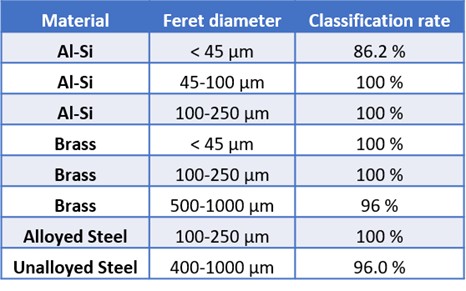
Table 1 and Table 2 show classification rates for nineteen different samples (Eleven bulk samples and eight particulate samples of different sizes down to 45 µm). The measurements on the bulk samples were performed in the same way as the measurements for building up the method. For the particles the number of laser shots was reduced depending on the size of the particles (two laser shots for particles smaller 45 µm and five laser shots for all other sizes). Prior to analysis spectra with very low intensity have been removed.
The results show classification rates above 95 % for nearly all samples. Even small particles could be classified with good classification rates (up to 100 %).
Supplementary Information
Table 1: Classification rate (percentage of correctly classified spectra) for bulk samples. The results are from five independent measurement sessions performed on different days. Within each session 64 spectra per material were recorded on different spots on the sample and the spectra were analyzed individually
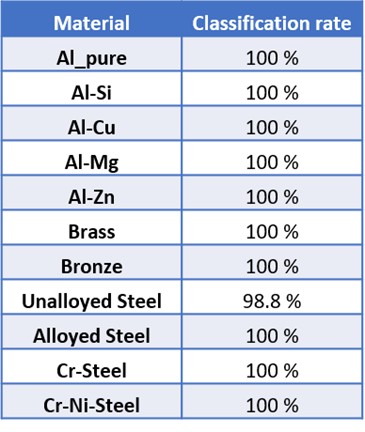
Table 2: Classification rate (percentage of correctly classified spectra) for particles. The results are from five independent measurement sessions performed on different days. Within each session five particles per size range and material were measured and the spectra analyzed individually.
To identify molecular structures with Raman spectroscopy the measured spectra can be transferred to the KnowItAll®-Database from Wiley and analysed.
Using the micro-LIBS-Raman system CORALIS a fast and precise determination of metal alloy types for bulk samples and particles is possible. Even when using only two laser pulses for microscopic particles with diameters of less than 50 µm, statistically valid reports about particle composition are still possible. By including even more reference samples also from other material types and classes (e.g., titanium- or tin-based), the presented method can be easily extended and made universally applicable.
References
M. Lanzinger, S. Kaufmann, M. Schuster, N.P. Ivleva, LIBS as a fast and reliable alternative to μXRF and SEM–EDX for quantitative analysis of aluminium alloy particles in technical cleanliness analysis. Microchem. J., 207 (2024), 111782
L. Pfeifer, V. Merk, S. Damaske, W. Werncke, Kombinierte LIBS- und Ramanspektroskopie zur Partikelanalyse. JOT, (2020)
M. Lanzinger, D. Huber, V. Merk, S. Kaufmann, M. Schuster, N. Ivleva, Development of laser-induced breakdown spectroscopy-methods for rapid element quantification in alloy particles in technical cleanliness analysis. Spectrochim. Acta B, 205 (2023), 106691.