


Aluminium Analysis with LIBS
Analysis of alloy composition of aluminium with LIBS technology
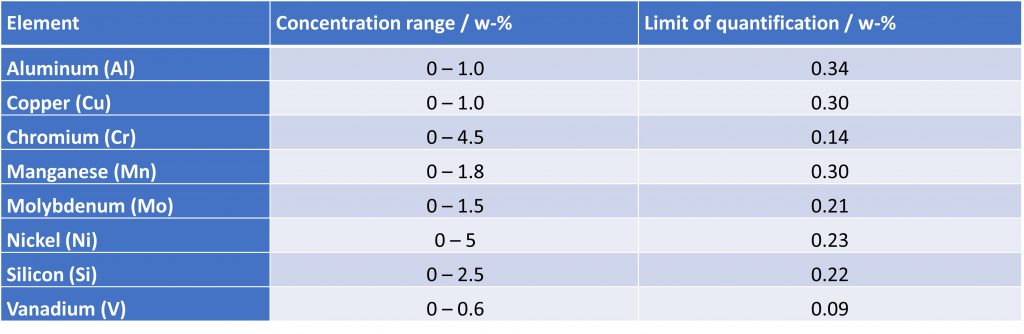
Knowing the elemental composition of aluminum and steel alloys is of high importance in many fields, e.g. quality control, material testing and homogeneity analysis. Laser-induced breakdown spectroscopy (LIBS) allows to quantify alloying elements as well as contaminations in aluminum and low-alloyed steel with short acquisition times. The CoRaLis system can come calibrated with preinstalled calibration models for aluminum and low alloy steel. Table1 and Table2 summarizes the concentration ranges that can be quantified and the limits of quantification for the current calibration methods.
Table 1: Concentration ranges and limits of quantification for the different elements that are quantified in aluminum.
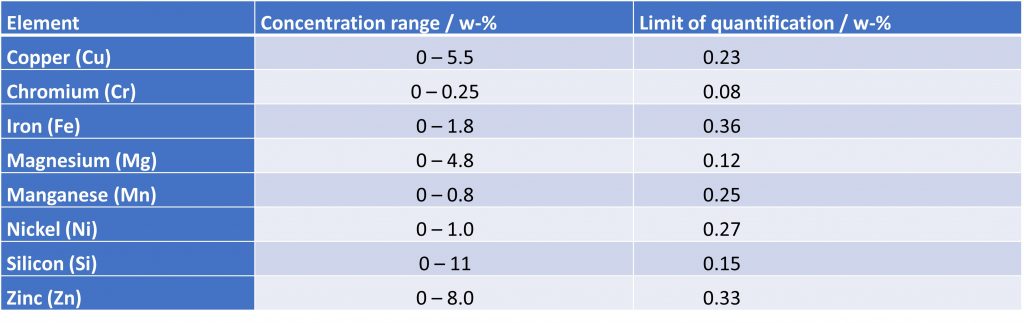
Table 2: Concentration ranges and limits of quantification for the different elements that are quantified in low alloyed steel.
The calibrations can be modified at the customer’s request, e.g., to achieve lower quantification limits or to include additional alloying elements. Prior to quantitative analysis, an attempt is always made to classify the sample material into three main classes—iron, aluminium, or copper-based—as well as into respective sub-material classes (up to 12 classes). The conditioned classification algorithm is based on PLS-DA and is continuously being further developed.
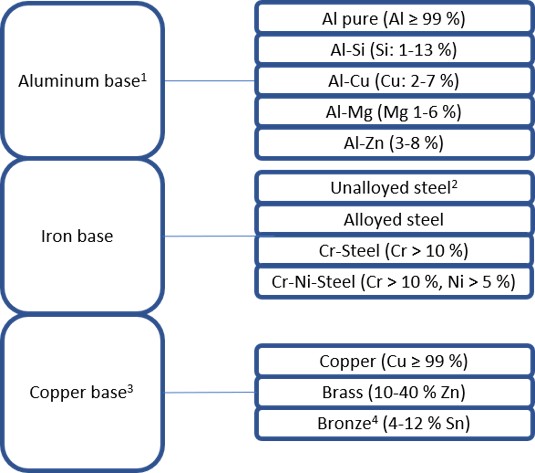
Figure 1: Overview of the material classes included in the method. 1Classification and Concentration ranges in
accordance to DIN EN 573-3:2019, 2Classification in accordance with EN 10029_2000, 3Classification in
accordance with „Deutsches Kupferinstitut“, 4incl. Gun Metal.
The determined concentration together with a sub material-class can be used to do a table look-up to retrieve further information about the material e.g. the material number according to the International Alloy Designation System. Also, user specific information can be stored in such a table and reported if they match the determined concentrations. For example, the result of the table look-up may be the assignment of a sample to aluminium material classes according to DIN EN 573-3 (see Table 1).

Table 3: Exemplary analysis result, showing the base class (class), the concentration values for the alloying elements and contaminations as well as the material number (Table Match).